
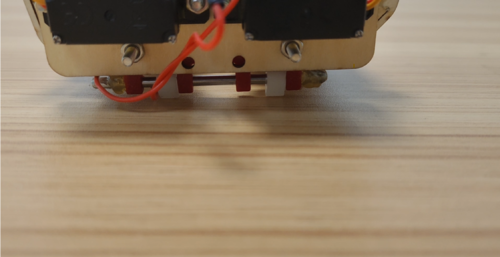
Two-way Movement Pattern
The non-directional characteristic gives the robot more flexibility when moving towards or turning in one specific direction, especially when farmlands have many branches and changes in elevation that might require constant adjustment on where to go.
Conceptual Design
The wheel design has two generations. One-way movement patterns use one-way bearings and friction wheels and rely on friction. Two-way movement patterns use isolation columns and silicone hoses and emphasize the combination of different modules. After two rounds of experiments testing the influence of the delay and the rotational angle on the speed, the robot with two-way movement patterns is more advantageous because it can move both forward and backward without losing behind on speed to a great extent. The figure below demonstrates the two movement patterns. The photos below correspond to one-way (two modules) and two-way (three modules) movement patterns.


Detail Design

Corresponding to one-way and two-way movement patterns, the physics behind the wheel design experienced two generations of advancements. Under one-way movement patterns, clockwise rotations generate low friction and counter-clockwise rotations generate high friction. When expanding, the clockwise rotation of the front wheel generates sliding friction, causing the robot to move rightward only because the rear wheels are pressed against the plane. When contracting, the counter-clockwise rotation of the front wheel stops the robot from moving because of high friction, and the rear wheel rotates clockwise and drives the latter part of the robot inward, causing the entire robot to move forward. Under two-way movement patterns, the wheels are unrestricted by friction to move in one specific direction. Because two sets of wheels have higher friction than one set of wheels, the former or latter section of the robot can expand or contract, driving the robot either forward or backward. Overall, robots with two-way movement patterns are advantageous.
